
Electrochemical corrosion test
Electrochemical testing is a rapid and precise way for evaluating how materials resist corrosion by analyzing their behavior in various environments and under specific working conditions
Key Benefits:
- Speed: Rapid analysis of corrosion behavior in minutes to days.
- Precision: Detailed characterization of corrosion rates and types in various environments.
- Versatility: Test materials in any electrolyte and simulate real-world conditions more effectively.
- Galvanic Corrosion Testing: Easily assess the impact of dissimilar metal contact (galvanic coupling) and how it affects corrosion resistance.
Can be applied to:
Our electrochemical testing can be performed using conductive metals, composites and 3D printed structures immersed in a variety of conductive electrolytes, including water, saltwater, or other customized conductive solutions upon request. The tests can be conducted at a wide range of temperatures, from room temperature (RT) to 80°C, providing flexibility to simulate real-world environments and evaluate material behavior under various conditions.
Tailored corrosion testing to meet your unique requirements
We specialise in tests designed to meet your specific demands and operational conditions, especially when it comes to non-standard requests. Our team works closely with you to build customized setups, ensuring the tests reflect the exact conditions you need. We collaborate throughout the process, helping you design the right testing approach and providing expert guidance on how to interpret the results, ensuring you receive the most accurate and relevant data for your application.
Test procedure:
Corrosion behaviour
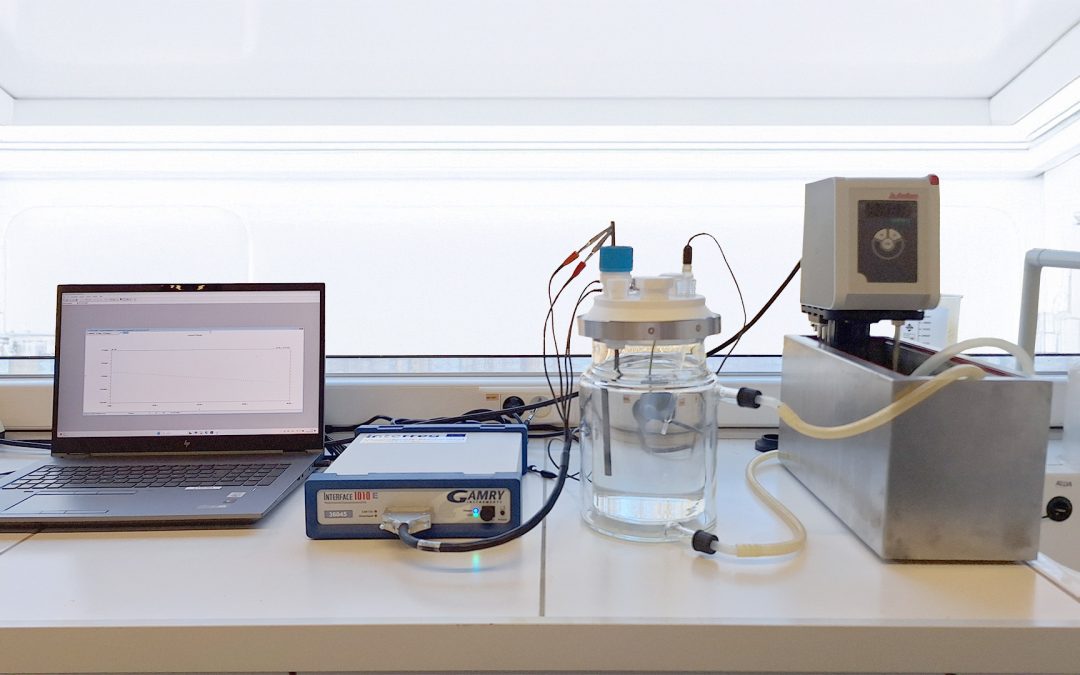
Using a 3-electrode electrochemical cell, consisting of a working electrode (test sample), reference electrode (Ag/AgCl; other on request) and counter electrode (graphite; other on request), the corrosion behaviour can be determined in a particular electrolyte at a certain temperature.
Using different techniques we can obtain:
- Corrosion behavior in a given environment
- Working potential of the test sample
- Uniform corrosion rate
- Passivation behaviour
- Pitting potential
Galvanic potential
By replacing the counter electrode by a second test metal, the potential of both metals connected is obtained in relation to the reference electrode. This method is often used in combination with the corrosion behaviour test of the metal of interest in order to determine what the impact of the second metal will be to the corrosion behaviour.
In addition to those tests, we offer the possibility to combine with optical microscopy, SEM/EDX or water analyses to determine the corrosion mechanism based on the visual appearance and chemical elements taking part in the process.
Lead time:
Lead time is project-based and set in agreement with the customer.
All tests – metals – conductive composites – 3D prints – environmental – corrosion – climate
About Sirris Testlabs
Since 1949, Sirris has been helping companies in Belgium to innovate. With our high-tech testing labs and our skilled material experts we want to support the Belgian manufacturing industry in testing and improving its products.
A division of

Accredited by

Copyrights © 2019. All Rights Reserved by Sirris. Check our Privacy Policy and Cookie Policy.